Payroll

2026 SA Salary Increase: January Update

2026 South African Salary Increase Forecast: January Update

In early November 2025, we published our 2026 South African Salary Increase forecast, outlining the methodology used to project future inflation and to determine a real salary increase. At the time, our forecast indicated a 5.00% salary increase for 2026. The full article can be read by clicking here.

The objective of this article is to revisit our inflation forecast and assess whether any new developments should influence the 2026 salary increase forecast. Two key factors have emerged that have affected our inflation expectations:

    1. South African Reserve Bank Governor Lesetja Kganyago recently announced a new inflation target of 3%, with a 1% tolerance band, replacing the previous target range of 3% to 6%. A lower target is one of the most powerful long‑term tools for reducing actual inflation. By anchoring expectations, it encourages more moderate wage‑setting and pricing behaviour, which helps to reduce underlying inflation pressures over time.

      At Axiomatic, we believe an inflation environment stabilising around 3% is likely to become the new norm.

    2. The rand has strengthened significantly, trading close to R16.00/USD, supported by the following factors:

A stronger rand generally helps to reduce the cost of imported goods, easing inflationary pressure.

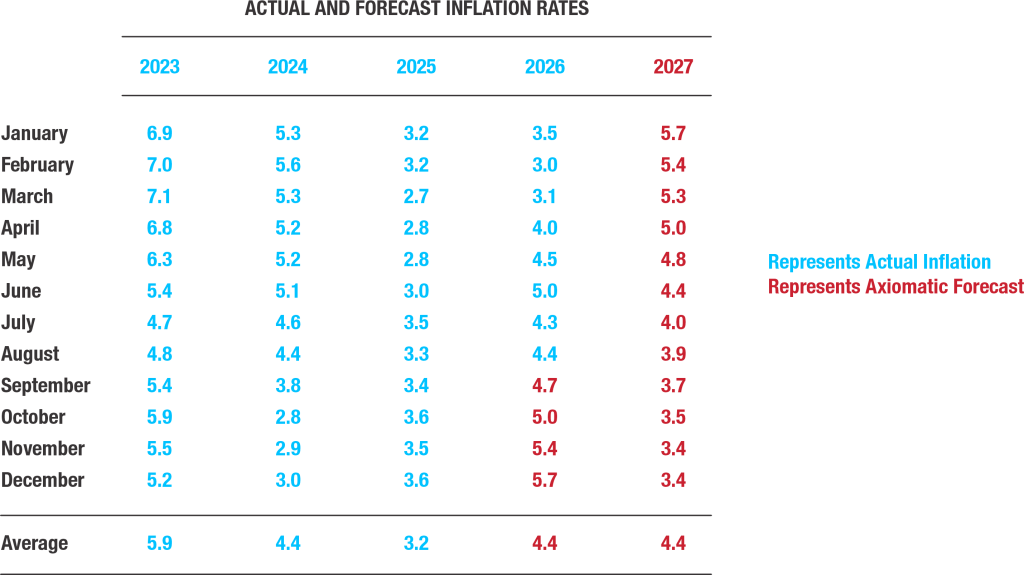
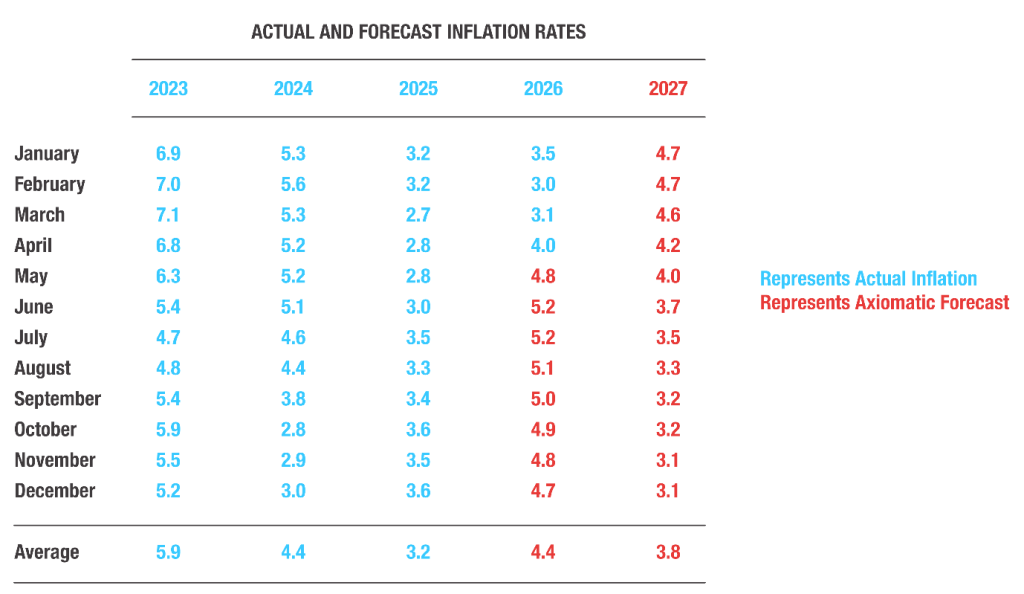
Given the two factors mentioned above, we have revised our inflation forecast for 2026 and 2027 to:

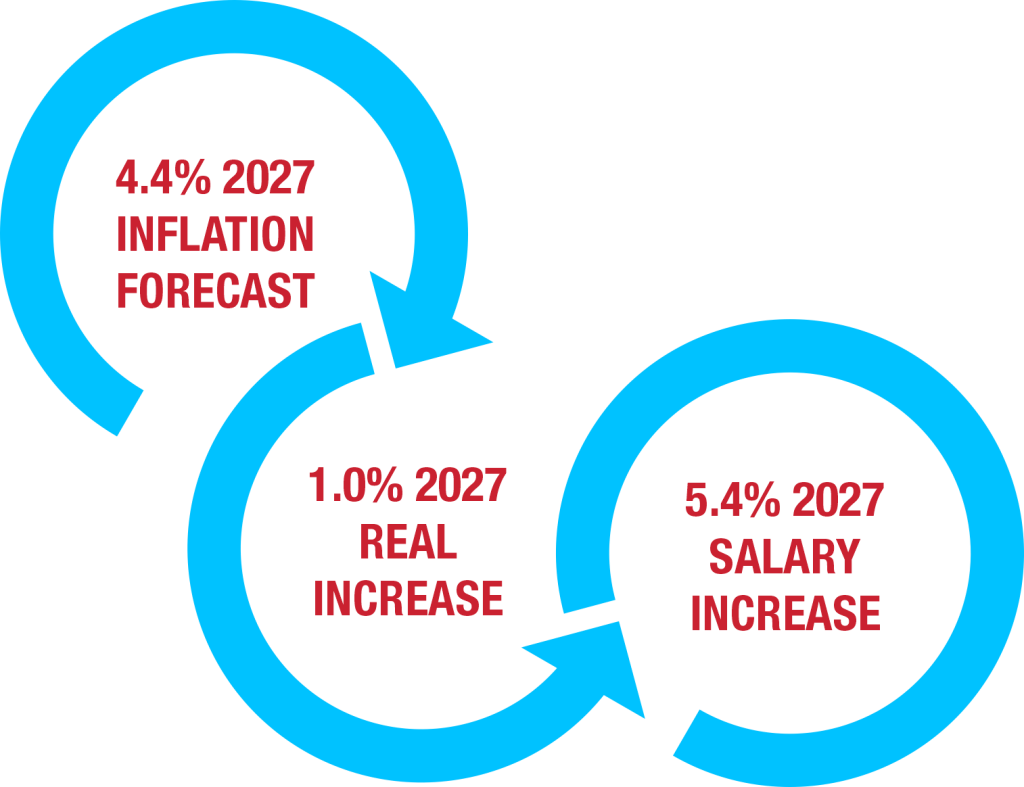
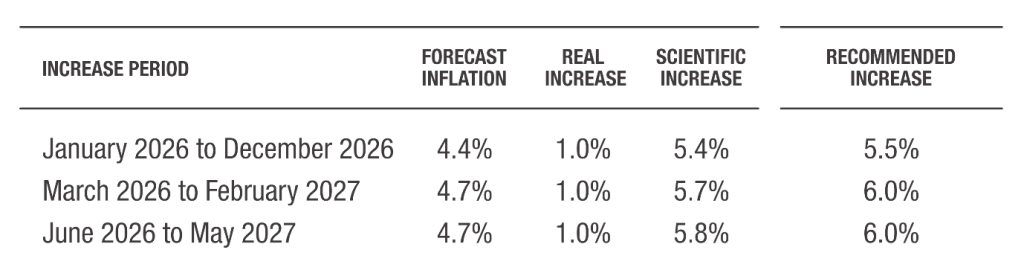
The scientific or mechanical methodology described in our November 2025 article would imply the following:

Our current SA Salary Increase forecast for 2026 is 4.50%.

Of course, this forecast excludes other quantitative factors such as union demands, your past compensation trends, and your company’s financial position. These must also be considered.

Over the coming months, Axiomatic will continue to refine our 2026 salary increase recommendation as new data emerges.

Refine Your 2026 Salary Strategy

Stay Ahead of the Curve by Accessing Axiomatic’s Latest Economic Data and Quantitative Analysis to Ensure Your Business Remains Competitive and Financially Prudent.

2026 SA Salary Increase: January Update Read More »

Why Your Dubai Payroll Needs an Update.

Why Your Dubai Payroll Needs An Upgrade

Historically, payroll in Dubai has been considered straightforward, and for good reason. With no income tax calculations, minimal social security requirements, and fewer complexities around allowances, many organisations managed salaries using Excel spreadsheets or basic payroll tools.

While this approach may have worked in the past, today’s business environment is different. As companies scale, employee expectations rise, and organizations strive to enhance their Employee Value Proposition, relying on outdated processes can lead to inefficiencies, errors, and compliance risks

Reality check: Payroll Is More Than Just Salary Calculations

Payroll isn’t just about paying employees. It’s about:
When payroll is handled manually or on simple and outdated platforms, these processes become time-consuming and prone to mistakes. This can impact employee satisfaction and increase administrative overheads.

Why Upgrade to a Modern Payroll Platform?

When payroll is handled manually or on simple and outdated platforms, these processes become time-consuming and prone to mistakes. This can impact employee satisfaction and increase administrative overheads.

1. Employee Self-Service

Modern payroll platforms like Deel Local Payroll empower employees through self-service portals, allowing them to:

This reduces HR workload and improves employee experience.

2. Automation and Accuracy

Automation eliminates repetitive tasks and minimises human error.

3. Integration with HR and Finance Systems

APIs allow seamless integration with HRIS and accounting systems, ensuring:

The payroll platform should have the ability to integrate with HRIS systems, including SuccessFactors, Workday or bespoke systems, finance and Time & Attendance systems. The Deel Local payroll includes a Performance Management module as a “bolt-on”.

3. AI: The Future of Payroll

Artificial Intelligence is transforming payroll:

5. Cybersecurity

Cybersecurity is a rapidly evolving risk for all companies. If your payroll platform is housed on your server, this amplifies the risk. As a minimum you should be using a cloud based system with ISO27001 and/or SOC I and Soc II compliance.

6. Strategic data

A good payroll platform generates rich, accurate, and timely data that can be leveraged for strategic decision-making. By consolidating information on labour costs, overtime trends, compliance metrics, and workforce demographics, the platform enables organisations to identify cost-saving opportunities, forecast staffing needs, and align compensation strategies with business goals.

Insourcing or Outsourcing

When managing payroll in Dubai, companies often weigh the benefits of outsourcing versus insourcing.

Outsourcing payroll services can be suitable for large organisations seeking to offload administrative complexity or where the salary structure is complex. However, this approach can be costly.
On the other hand, insourcing—where a world-class payroll platform is provided and integrated with the company’s internal processes—offers greater control, flexibility, and cost efficiency. Insourcing allows businesses to maintain ownership of sensitive data and tailor workflows to their unique requirements, while still leveraging advanced technology and compliance support.
Ultimately, the choice depends on balancing cost, control, and operational priorities.
Do you want to chat about moving your payroll into the cloud and into the future?

Why Your Dubai Payroll Needs an Update. Read More »

2026 SA Salary Increase

2026 SA Salary Increase: What Salary Increase Will You Use?

“Sharon, please could you give Bob from Finance the forecast salary increase percentage for 2026 and the projected increase in our salary cost?”

This request often sparks a sense of urgency and foreboding—it signals that the annual salary increase process is imminent, along with all the associated challenges of union negotiations, heated discussions, and hard work.

However, preparing the forecast is not as daunting as it seems. We have long advocated for a scientific approach to the preliminary salary increase forecast. Start with an initial estimate, then refine it over the coming months as economic data unfolds. Finally, incorporate qualitative factors to formulate an equitable final salary increase for 2026.

Inflation

The first step in the forecasting process is determining the expected inflation rate for 2026. Salary increases are closely tied to inflation because employees aim to maintain their purchasing power year over year.

Consistent with the Axiomatic methodology, we recommend a forward-looking approach—forecast inflation for 2026 and base the proposed salary increase on that projection. This method calculates the portion of the increase that will be absorbed by inflation. In contrast, the backward-looking approach, which uses the previous year’s inflation rate, is less effective because past inflation is already “sunk” and does not influence future purchasing power.

Axiomatics’ inflation forecast for the remainder of 2025, 2026 and 2027 is detailed in the table below:

Surprisingly, our inflation forecast is closely aligned with the MPC Committee’s November 2025 forecasts:
The lower inflation outlook may surprise some, but it reflects the new inflation target announced by SARB Governor Lesetja Kganyago at the November 2025 MPC meeting:

… we have moved away from the 3-6% target range, which was established 25 years ago. The revised target, agreed between the Minister of Finance and myself as the Governor of the South African Reserve Bank, is 3% plus or minus 1 percentage point… Most of the time, we should be expected to keep inflation within the tolerance band, with breaches occurring only when there are severe shocks. We will always be setting policy so that inflation is going back to 3%… The tolerance band, of 1 percentage point either side of 3%, does not mean we will be indifferent to inflation anywhere between 2% and 4%. We want to be at 3%.

This shift implies tighter monetary policy going forward, anchoring inflation—and expectations—around 3%.

Real Salary Increase

The next step is determining the real increase, which is the portion of the salary increase above inflation. For example, if salaries rise by 5% and inflation is 3%, employees receive a 2% real increase.
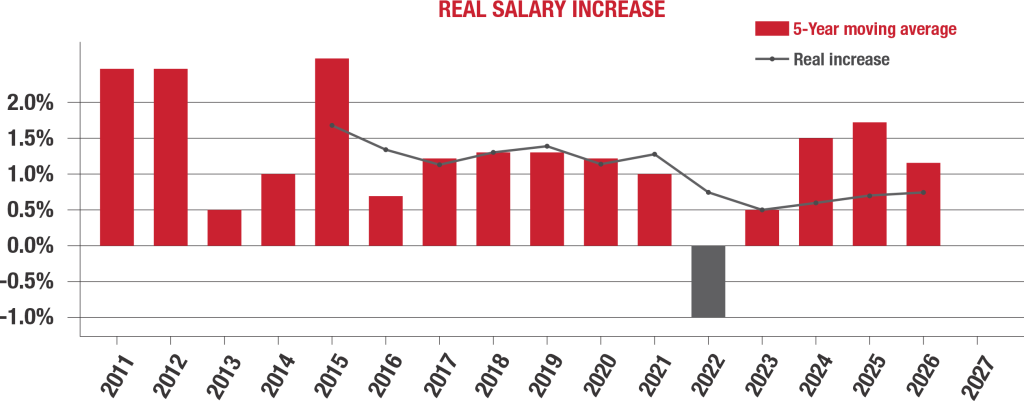
Historically, South African companies added a 2% real increase to inflation when setting salary adjustments. However, recent trends show smaller real increases. The five-year moving average has declined, partly due to anomalies in 2022 and 2023 when inflation exceeded expectations, eroding real increases.
Today, the general “rule of thumb”, is that a 1.0% real salary increase is the “new normal”. However, one must take cognisance of the fact that the average 5 year real increase is only 0.6% because of 2022 and 2023.

FORECAST OF 2026 SALARY INCREASE

The scientific approach would conclude that an equitable salary increase would therefore be:

However, our current forecast salary increase for 2025 is thus 5.00%.

We do acknowledge that this represents a 1.3% real increase. Even with this adjustment, the five-year average real increase remains modest at 0.7%.

Of course, this forecast excludes other quantitative factors such as economic growth, union demands, compensation trends, and your company’s financial position. These should be considered closer to implementation.
Over the coming months, Axiomatic will continue to refine our 2026 salary increase recommendation as new data emerges, incorporating quantitative factors and market trends.

Stay ahead of the curve, contact us for the latest insights and ensure your business remains competitive!

Refine Your 2026 Salary Strategy

Stay Ahead of the Curve by Accessing Axiomatic’s Latest Economic Data and Quantitative Analysis to Ensure Your Business Remains Competitive and Financially Prudent.

2026 SA Salary Increase Read More »

King V – The New Era of Corporate Governance Excellence 

King V - The New Era of Corporate Governance Excellence

The Institute of Directors in South Africa (IoDSA) adopted the final version of the King V Code on Corporate Governance on 31 October 2025. This update refines local governance standards and simplifies the code for easier applications, while retaining the core principles of King IV.

SCOPE AND STRUCTURE

King V applies to all organisations, including retirement funds and insurers. It is structured into four parts:

  1. Foundational Concepts
  2. The Code. 
  3. Glossary
  4. Disclosure Framework

The code uses an “apply and explain” disclosure system and provides a reporting template to guide organisations.

Key Focus Areas

King V emphasises:

It is outcomes-based and becomes effective on 1 January 2026, with early adoption encouraged to enhance governance and transparency.

Major Changes from King IV

• Reduction and Consolidation: Principles reduced from 17 to 13, merging related concepts for clarity.
• Language and Accessibility: Plain, jargon-free language for broader applicability.
• Independence Criteria: Strengthened rules; board members lose independence after nine years.
• Risk and Compliance Integration: Combined into a single principle for unified oversight.
• Enhanced Disclosure: Formal framework with templates under the “apply and explain” regime.
• Outcome Emphasis: Greater focus on evidence of governance effectiveness, not just process.
• Updated Governance Themes: Explicit inclusion of technology governance and removal of the separate institutional investor principle.

The 13 Principles Summarised

The governing body:

1. Leads ethically and effectively.
2. Governs ethics to promote an ethical culture and responsible corporate citizenship.
3. Aligns purpose, strategy, and business model for sustainable value.
4. Oversees external reporting for holistic stakeholder assessment.
5. Ensures balanced composition with diversity, skills, and independence (9-year tenure limit).
6. Manages delegation to committees and individuals effectively.
7. Appoints and delegates to management with clear accountability.
8. Governs risk and compliance strategically.
9. Ensures compliance with laws, codes, and standards ethically.
10. Governs data, information, and technology to support objectives.
11. Ensures fair, responsible, and transparent remuneration.
12. Promotes effective assurance and internal control for accurate reporting.
13. Adopts a stakeholder-inclusive approach for long-term interests.

In our opinion, the introduction of King V is widely regarded as a positive and timely evolution in South African corporate governance. By simplifying language and consolidating principles, it makes governance more accessible and practical, especially for smaller organisations that previously found King IV complex. The integration of technology governance and enhanced disclosure framework reflects modern business realities, ensuring boards remain accountable in a digital and data-driven environment.

The nine-year independence limit is a welcome move to strengthen board objectivity, while the outcomes-based approach aligns governance with real-world impact rather than mere compliance.

Overall, King V is expected to improve transparency, stakeholder trust, and organisational resilience, making it a highly recommended adoption for all entities.

Ready to Enhance Your Governance?

Please feel free to contact us today to explore how King V can build a more resilient and transparent organisation.

King V – The New Era of Corporate Governance Excellence  Read More »

Payroll Systems Fail: The Critical Need for Integration Ownership

Bridging the Gap Between Payroll and other systems: Why Great Systems Still Fail Without the Right Expertise

In a world where digital transformation is reshaping every function of business, payroll should be the one process that just works. Yet across industries, even large, established companies find themselves wrestling with payroll errors, manual corrections, and growing inefficiencies — despite having invested heavily in world-class technology.
So, what’s really going wrong?

Let’s look at a real example

A leading African manufacturer recently experienced persistent payroll issues following the rollout of a new HR and payroll system and integrating both systems. The payroll system itself was was robust, and the internal payroll team highly capable. On paper, it should have been a smooth success story. But reality told a different story.

The Perfect Setup That Went Sideways

After implementing a new payroll platform and connecting it to their HR system, the company began to experience a wave of small but costly problems:

Everyone did their job well, but the systems didn’t talk to each other properly. The cracks between platforms began to show, and inefficiencies piled up.

The Root Cause: Integration Without Ownership

The investigation uncovered a pattern we see often:

What was missing was the glue, someone who could translate operational payroll logic into technical integration solutions.

The Turning Point

Instead of overhauling the system, the company chose a smarter route — they brought in integration expertise.

This single step changed everything:

Within months, accuracy improved, costs dropped, and employee confidence was restored.

The Lesson for Every Business

Technology doesn’t fail because it’s bad — it fails because it’s misunderstood.

Too many businesses invest in the right systems, but forget to invest in the person or process that connects them.

That’s where integration specialists or business analysts come in. They’re not just IT resources — they’re the translators between payroll and technology, ensuring both worlds understand each other perfectly.

The Takeaway

If your payroll system looks great on paper but struggles in practice, the problem may not be your platform or your people — it might be the space between them.

Integration isn’t an afterthought. It’s a business-critical function.

And getting it right can mean the difference between chaos and clarity.

Stop the Payroll Chaos

Don’t let the gap between your systems keep driving up costs and causing errors. Your technology is sound, and your team is capable. What’s missing is the expertise to manage that critical integration layer. Find out how we can help you implement true integration ownership to restore accuracy and employee confidence.

Payroll Systems Fail: The Critical Need for Integration Ownership Read More »

2026 Salary Increase Forecast For Nigeria

As we approach the budgeting season for 2026, the dreaded question will soon be asked:

“What 2026 salary increase can we use for the Nigeria budget?”

Implementing a salary increase that is fair to all stakeholders in Nigeria has been a significant challenge in recent years. The primary reason has been the persistently high inflation rate. In 2024, the average inflation was 33.2%, and we forecast an average of 21.06% for 2025.

Clearly, most companies we not able to match inflation with equivalent salary increases. In response, we previously recommended that employers consider introducing an Inflation Allowance to help mitigate the impact on employees. (You can view that article by clicking here.)

Considering Real Salary Growth

In addition to inflation, it’s important to factor in real salary increases. Employees have experienced negative real wage growth in both 2024 and 2025. Unfortunately, we are only forecasting 3.9% GDP growth for 2026, which suggests limited room for aggressive salary increases without impacting company profitability.

Considering Real Salary Growth

There is cautious optimism that 2026 may be more manageable. The graph below illustrates historical inflation trends alongside our forecast for 2026:

While inflation in Nigeria remains difficult to predict, we are confident it will continue to decline throughout 2026. This view is supported by the Monetary Policy Committee (MPC), which stated at its 23 September meeting:

“Staff projections suggest a sustained disinflation over the coming months, driven by the lagged effects of previous rate hikes, continued stability in the foreign exchange market, and a decline in the price of PMS.”

Recommendation

Based on our analysis of inflation trends, economic growth, and employee welfare, we recommend a salary increase of 16.5% for 2026. This figure aims to balance affordability for employers with the need to restore purchasing power for employees.

We recently formulated our preliminary salary forecast for Ghana – another country which presented immense problems over the last two years – you can read that article by clicking here.

Ready to Finalise Your 2026 Budget?

Need assistance with your 2026 Nigeria payroll and budget planning? Contact us today to discuss how to implement a fair and affordable salary increase strategy.

2026 Salary Increase Forecast For Nigeria Read More »

COOKIE POLICY

Welcome to our website.

1. Introduction

This Cookie Policy explains how we use cookies and similar technologies on our website axioconsult.com. This policy is designed to help you understand what cookies are, how we use them, and the choices you have regarding their use.

2. What Are Cookies

Cookies are small text files that are stored on your device (computer, tablet, or mobile phone) when you visit certain websites. They are widely used to enhance your online experience by remembering your preferences and actions over time. Cookies are not harmful and do not contain personal information like your name or payment details.

3. How We Use Cookies

We use cookies for various purposes, including:

    • Essential Cookies: These cookies are necessary for the basic functioning of our website. They enable you to navigate our site, use its features, and access secure areas.
    • Analytical/Performance Cookies: These cookies help us understand how visitors use our website. They provide information about which pages are visited most frequently, how long visitors stay on each page, and whether they encounter any error messages. This data helps us improve the performance and usability of our website.
    • Functionality Cookies: These cookies allow our website to remember choices you make (such as your username, language, or region) and provide enhanced, personalised features.
    • Targeting/Advertising Cookies: These cookies are used to deliver advertisements that are relevant to your interests. They may also limit the number of times you see an ad and help measure the effectiveness of ad campaigns.


4. Your Cookie Choices

You have the option to manage your cookie preferences. You can usually modify your browser settings to accept, reject, or delete cookies. Please note that if you choose to block or delete cookies, some features of our website may not function properly.

5. Third-Party Cookies

We may allow third-party service providers to use cookies on our website for the purposes outlined in Section 3. These providers may also collect information about your online activities over time and across different websites.

6. Updates to This Policy

We may update this Cookie Policy from time to time to reflect changes in technology, law, or our data practices. Any changes will become effective when we post the revised policy on our website.

7. Contact Us

If you have any questions about our Cookie Policy or how we use cookies on our website, please contact us at

By continuing to use our website, you consent to the use of cookies as described in this Cookie Policy.