


Retirement Fund Contributions
Retirement Fund Contributions
NEW Requirements - FSCA Conduct Standard 1 of 2022
The Financial Sector Conduct Authority (FSCA) has issued new requirements for contributions, contribution statements, and reporting around contributions. It wants to standardise the manner and format of reporting by funds regarding contribution matters.
On 19 August 2022, the FSCA issued Conduct Standard 1 of 2022 which deals with:
- the payment of contributions to retirement funds by employers;
- the information and statements to be made by employers in contribution statements provided by employers to funds;
- reporting of contributions and contribution statement problems (in prescribed formats); and
- the content of attorney-fund agreements where attorneys are recovering contributions from employers for the fund.
Conduct Standards are law.
Effective date
The effective date of the Conduct Standard is six months after the date of publication, i.e. 19 February 2023 [1].
Duty of the fund - notify employers of their contribution duties
A fund must notify every participating employer before the employer starts participating in the fund, and then every year, of the employer’s duties, obligations, and liability under section 13A of the Pension Fund Act (PFA) and the Conduct Standard. This must be done in the prescribed format.
It appears, from the consultation report, that funds may do this annual notification at any time in the year and not necessarily on the anniversary date of participation.
Contribution statements are to be provided by the employer to the fund.
The employer must provide the following contribution statements to the fund:
The initial contribution statement, which is the first contribution statement provided to a fund by an employer after the employer begins participating in the fund must, at a minimum, include:
- the name of the fund;
- the fund registration number;
- the period in respect of which the contribution is payable;
- the name and address of the employer;
- where an employer has multiple pay-points, the pay-point which made the deduction;
- the contact person responsible at the employer or pay-point dealing with inquiries relating to contribution statements and payment of contributions;
- the identity of the person envisaged in section 13A(8) of the Act, as requested from the employer by the fund in terms of section 13A(9)(a) of the Act;
- in respect of each member, the following:
- full name;
- date of membership;
- date of birth;
- South African identity number or passport number;
- employer pay or industry number;
- income tax number;
- contact number, including (where available) cellular phone number;
- e-mail address (where available);
- postal address;
- residential address;
- annual pensionable emoluments;
- percentage and amount of contributions;
- split between member and employer contribution; and
- details of any additional voluntary contributions paid.
A subsequent contribution statement means any contribution statement provided to a fund by an employer subsequent to the initial contribution statement and must, at a minimum, include:
- all the information in the initial contribution statement, (except that the information in subparagraph (g) above need only be provided if the identify of this person has changed as compared to the previous contribution statement);
- the membership number allocated to each member by the fund; and
- an indication of any changes as compared to the contribution statement for the previous period showing any differences in the data, including additions as a result of new members, reductions as a result of membership terminations, adjustments as a result of changes in pensionable emoluments, the payment of additional voluntary contributions, corrections due to error or any other information that may be relevant.
The Conduct Standard places the obligation on the employer to ensure that differences in membership data from month to month are provided to the fund. In addition, the employer must provide any other information that may be relevant to the membership data. Examples could include, in our view, information about upcoming changes within the employer that might impact on membership data.
Even where the administrator, on behalf of the fund, is tracking changes in members’ data from one month to the next and reporting on this, the employer retains the obligation to do so.
It is important that the FSCA will be able to use its enforcement powers (in the Act and in the Financial Sector Regulation Act) against the employer to enforce compliance with the Conduct Standard. This is in line with what we are seeing under the draft Conduct of Financial Institutions Bill, where the employer, with respect to contributions, will be a supervised entity and subject to the supervisory and enforcement powers of the FSCA (with respect to contributions).
Furthermore, we should not forget that the FSCA has said that it will ‘name and shame’ employers and funds where contributions are unpaid/short-paid. The FSCA recently announced that it will commence with this initiative in October 2022.
A new requirement is that all information to be provided by the employer in contribution statements must be accompanied by a declaration by the employer that all employees eligible to be members of the fund are accurately reflected in the contribution statement. Again, this places an obligation on the employer to ensure that all eligible employees appear on the contribution statements provided to funds.
The Act provides that contribution statements must be provided either at the time of paying contributions or not later than 15 days after the end of the month in respect of which the contribution payment is made.
Note that it is the minimum information to be provided in contribution statements that are prescribed in the Conduct Standard and the fund may ask the employer for additional information.
Reporting
Although the Conduct Standard does not number the reports, we have done so below to aid understanding.
REPORT 1
Reporting on receipt of contributions and data to the principal officer / monitoring person [2]
The person who is responsible for checking the receipt of contributions must report not later than fifteen days after the end of the period allowed to make the contributions (not later than seven days after the end of the month) to the principal officer or monitoring person:
- whether any matters previously reported on were not resolved;
- if the contribution statements data was not provided as required;
- where the payment of contributions and the data in the contribution statements cannot be reconciled with each other, except if the discrepancy is less than 2,5% of the total contribution payable for the relevant period (“the allowable discrepancy”); and
- if any contributions have not been received as required by the Act except for the allowable discrepancy.
REPORT 2
Principal officer / monitoring person report to the board of the fund
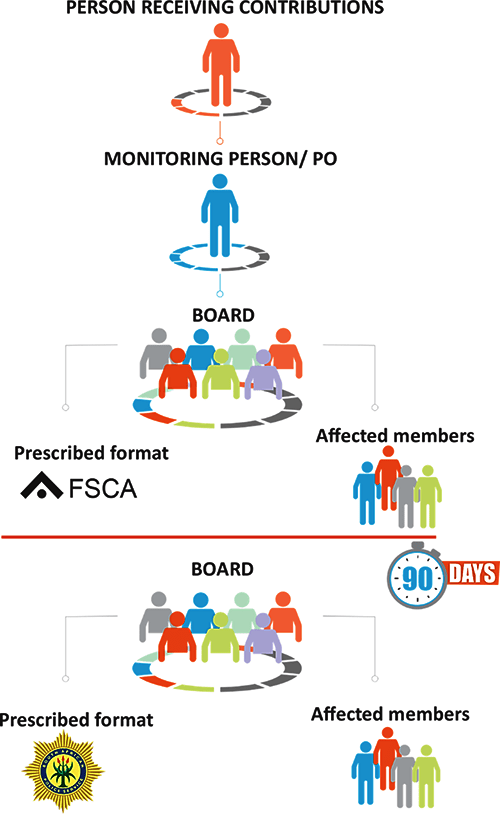
The principal officer of a fund or monitoring person must, within seven days after the receipt of report one, submit a written report to the board in respect of every relevant employer, if the employer:
- has not provided the contribution statements,
- not provide them on time,
- contributions have not been paid to the correct entity within the required time set out in the Act (see above); or
- if the previous non-compliance is still unresolved (S13A requirements).
Report two must include details of:
- whether any of the matters previously reported on were not resolved; and
- any instance where contribution payments and the contribution statement cannot be reconciled with each other, except for the allowable discrepancy.
REPORTS 3 & 4
Reports by the board of the fund
The board must ensure that any material contravention of, or material failure to comply with S13A requirements is, within 30 days of the board being informed in writing of the failure by the monitoring person:
- REPORT 3: brought to the attention of each affected member, in an appropriate manner. If the affected members cannot be identified, then the board must bring the contravention/ failure to the attention of all the members of the fund or all the members of the fund in respect of that participating employer; and
- REPORT 4: reported to the FSCA, in a format to be prescribed by the FSCA. The report must include the proposed course of action taken by the fund to remedy the contravention/ failure.
- “in writing” or “written” includes any communication by any appropriate electronic medium that is accurately and readily reducible to written or printed form. The communication must be clear, concise, comprehensive, and in a language that is easily understood.
REPORTS 5 & 6
By the board of the fund
Any material contravention of, or material failure to comply with the S13A requirements that continues for a period of 90 days must be reported by the board:
REPORT 5: in sufficient detail to the South African Police Service, in a format prescribed by the FSCA, within 14 days after the expiration of the 90-day period; and
REPORT 6: in writing to affected members or, where the affected members cannot be identified, all the members of the fund or all the members of the fund in respect of that participating employer, within 14 days after the expiration of the 90-day period.
Interest on late payment of contributions
According to the Conduct Standard, interest is payable on late payment of contributions or unpaid contributions, where contributions (or part of contributions) are paid after the prescribed period for payment. This interest is investment income for the fund.
Calculation
Interest is calculated from the first day following the expiration of the period contributions were payable until the fund receives the contributions.
Interest is calculated at the prime rate plus two percent. The fund and the employer may not agree that some other rate of interest will be paid or that no interest will be paid.
When is it payable?
The interest is payable to the fund by no later than the end of the second month following the month in respect of which the amount is payable.
Outsourcing by the fund to an attorney for the recovery of contributions
The Conduct Standard contains requirements for the fund’s board, which decides to outsource the recovery of contributions from an employer to an attorney. These are set out below.
Conflicts of interest
The board must have regard to:
- any actual or potential conflict of interest that may exist in the selection and appointment of the collecting attorney; and
- any board-approved policies of the fund relating to conflict of interest and outsourcing; and ensure that any conflict of interest is avoided.
Attorneys’ fees
The board must ensure that fees payable to the attorney for collection of arrear contributions are:
- reasonable and commensurate to the service provided; and
- do not impede the delivery of fair outcomes to members and the fund.
Agreements with attorneys
Where an attorney is appointed to recover contributions for a fund, the fund’s board must enter into an agreement with the attorney. The agreement must provide for at least the following:
- that any amount recovered by an attorney in respect of contributions must be transmitted into the fund’s bank account within seven business days of receipt of the amount;
- the fee structure;
- specific instructions relating to the steps the attorney must take if the employer fails to pay the arrear contributions on demand;
- anticipated timelines for recovering all arrear contributions by the attorney; and
- frequency of reporting by the attorney to the fund about payments made by the employer.
Preparation
During the six-month phase-in period, administrators and funds will need to decide which processes, communication, and documentation they need to amend as well as consider their current systems and policies.
Retirement Fund Contributions Read More »


