


Fair Pay Starts with Fair Job Grading
You Can't Have Fair Pay Without Fair Job Grading
South African employers may soon face a significant change in the way salaries are determined, disclosed and discussed.
The proposed Fair Pay Bill, which seeks to amend the Employment Equity Act, is intended to strengthen pay transparency and address persistent remuneration inequalities. Among its key proposals are restrictions on employers asking job applicants about their current or previous remuneration, requirements to disclose remuneration or remuneration ranges in job advertisements and on request, and greater freedom for employees to discuss remuneration.
The proposed amendments also specifically bring salary benchmarking and remuneration ranges for a job or position into the definition of an employment policy or practice.
While the Bill is not yet law, it raises an important question that employers should arguably already be asking: if we are required to be more transparent about what a job pays, can we objectively explain why the job is worth what we say it is? That is where job grading becomes increasingly important.
The Problem With Using Historical Salary
Traditionally, remuneration decisions during recruitment have often started with two simple questions: “What are you currently earning?” and “What salary are you looking for?” An offer might then be pitched at a percentage above the candidate’s existing salary.
The difficulty with this approach is that it can perpetuate existing inequalities. If an individual has historically been underpaid, using that salary as the starting point when determining their next salary may simply carry the inequality into their next position.
This is specifically one of the practices the Fair Pay Bill intends to address. Its stated objective is to shift the focus away from historical remuneration and towards the skills and experience of the candidate and the value of the role itself. But that creates another question: how does an employer objectively determine the value of the role?
Start With The Job, Not The Person
A scientifically structured job-grading methodology evaluates the job itself, rather than the individual occupying it. That distinction is critical.
Two people may have different qualifications, performance levels, years of service and salaries while occupying jobs of broadly the same organisational value. Conversely, two positions with similar job titles may have substantially different levels of accountability, complexity and organisational impact. A job title alone therefore tells us very little about what a job is worth.
A structured job-evaluation process considers defined factors such as:
- The knowledge and experience required
- The complexity of the work
- Thinking and problem-solving requirements
- Planning and integration
- Communication requirements
- Leadership responsibilities
- Organisational impact
- Accountability and the consequences of error
This is the approach incorporated into Axiomatic’s AxioJob methodology. The system evaluates roles against a consistent set of factors and uses the results to determine their relative organisational value.
Importantly, job grading does not determine what an individual employee should be paid. It provides the objective architecture upon which an organisation can build a remuneration structure.
Equal Work Does Not Necessarily Mean Identical Pay
This distinction becomes particularly important in discussions around pay equity. Fair remuneration does not necessarily mean that every employee performing the same or similar job must receive exactly the same salary.
Consider two employees occupying positions at the same grade:
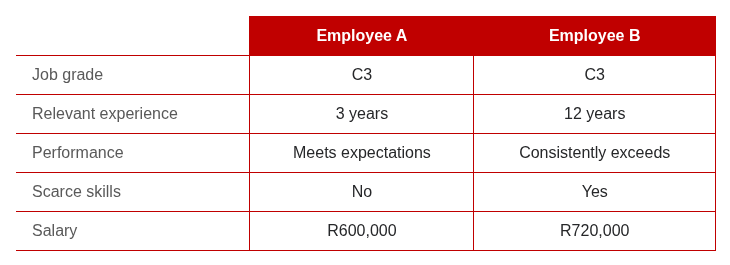
The salary difference may be entirely rational and defensible. The important issue is whether the employer can objectively explain both decisions: why are the jobs regarded as being of equivalent organisational value, and why are the employees positioned differently within the applicable remuneration range?
A sound grading framework helps answer the first question. A properly designed remuneration policy and salary-band structure should answer the second.
This distinction is fundamental. Job grading determines the relative value of the job. Salary architecture determines the remuneration range for that grade. Defined remuneration criteria then determine where an individual should appropriately be positioned within that range.
Why Scientific Job Grading Matters
Without a structured grading methodology, organisations can easily end up (and often do) with remuneration practices based on job titles, individual negotiation, historical salaries, manager discretion or what was necessary to recruit someone at a particular point in time. Over several years, those individual decisions accumulate.
The result can be:
- Employees performing work of similar value sitting on very different salary levels
- Inconsistent job titles and grades
- Unjustified differences between departments
- Salary compression
- Employees being promoted but remaining incorrectly positioned
- Overpayment or underpayment relative to a job's actual organisational value
- Remuneration differences that become increasingly difficult to explain
A structured job-evaluation framework does not automatically eliminate these problems. It does, however, provide an objective and consistent reference point against which they can be identified and addressed.
Where AxioJob Fits
AxioJob was developed by Axiomatic as an online, cloud-based job-grading system that allows organisations to conduct structured job evaluations internally.
Rather than relying on an evaluator’s subjective view of what a position “feels like”, the evaluator works through a structured series of questions covering Work Expertise, Work Processing and Work Impact. The system then scores the role and determines its grade.
The methodology deliberately evaluates the position rather than the incumbent. Performance, potential and an employee’s current salary are not used to inflate or reduce the grade of the job.
AxioJob can also correlate grading outcomes with established grading methodologies including Paterson, Hay, Mercer and Willis Towers Watson, or an organisation’s own internal grading structure.
The result is not simply a grade. It provides an organisation with the foundation for a coherent remuneration architecture: Job Description → Job Evaluation → Grade → Salary Range → Employee Positioning. It is that chain that becomes increasingly valuable in an environment of greater remuneration transparency.
Pay Transparency Changes The Remuneration Conversation
If the Fair Pay Bill becomes law in its proposed form, employers will increasingly need to be able to articulate their remuneration ranges to employees and applicants.
Simply publishing salary ranges, however, does not create pay equity. The more fundamental requirement is having confidence that those ranges are attached to jobs that have themselves been evaluated consistently and objectively.
For many employers, therefore, preparation for increased pay transparency should not start with the salary range. It should start one step earlier and answer the question: are our jobs properly defined, evaluated and graded?
Only once an organisation establishes the relative value of its jobs can it build meaningful salary bands, benchmark those jobs against the external market and establish rational rules for positioning employees within those bands.
The Question Employers Should Be Asking Now
The Fair Pay Bill may still evolve during the legislative process. Employers should therefore not treat its proposals as existing statutory requirements.
But the direction of travel is clear: greater transparency, greater scrutiny and a growing expectation that remuneration decisions can be objectively explained. This makes structured job evaluation much more than an HR administrative exercise. It becomes part of an organisation’s remuneration governance.
A company with current job descriptions, consistently evaluated positions, clearly defined grades, market-informed salary ranges and documented rules for employee positioning, is in a substantially stronger position to explain why Job A is worth what it is, why Employee B sits where they do within the range and why apparently similar employees may legitimately be paid differently.
That is ultimately what fair pay should mean: not necessarily identical pay, but remuneration decisions that are consistent, objective, explainable and defensible. And that starts with understanding the value of the job.
Ready to see AxioJob in action? Watch the short overview or arrange a demonstration with Brett Hopkins at Brett.Hopkins@axioconsult.com.
COOKIE POLICY
Welcome to our website.
1. Introduction
This Cookie Policy explains how we use cookies and similar technologies on our website axioconsult.com. This policy is designed to help you understand what cookies are, how we use them, and the choices you have regarding their use.
2. What Are Cookies
Cookies are small text files that are stored on your device (computer, tablet, or mobile phone) when you visit certain websites. They are widely used to enhance your online experience by remembering your preferences and actions over time. Cookies are not harmful and do not contain personal information like your name or payment details.
3. How We Use Cookies
We use cookies for various purposes, including:
- Essential Cookies: These cookies are necessary for the basic functioning of our website. They enable you to navigate our site, use its features, and access secure areas.
- Analytical/Performance Cookies: These cookies help us understand how visitors use our website. They provide information about which pages are visited most frequently, how long visitors stay on each page, and whether they encounter any error messages. This data helps us improve the performance and usability of our website.
- Functionality Cookies: These cookies allow our website to remember choices you make (such as your username, language, or region) and provide enhanced, personalised features.
- Targeting/Advertising Cookies: These cookies are used to deliver advertisements that are relevant to your interests. They may also limit the number of times you see an ad and help measure the effectiveness of ad campaigns.
4. Your Cookie Choices
You have the option to manage your cookie preferences. You can usually modify your browser settings to accept, reject, or delete cookies. Please note that if you choose to block or delete cookies, some features of our website may not function properly.
5. Third-Party Cookies
We may allow third-party service providers to use cookies on our website for the purposes outlined in Section 3. These providers may also collect information about your online activities over time and across different websites.
6. Updates to This Policy
We may update this Cookie Policy from time to time to reflect changes in technology, law, or our data practices. Any changes will become effective when we post the revised policy on our website.
7. Contact Us
If you have any questions about our Cookie Policy or how we use cookies on our website, please contact us at
By continuing to use our website, you consent to the use of cookies as described in this Cookie Policy.