

2027 South African Salary Increase Forecast

What Salary Increase Should We Budget For 2027?
This familiar question marks the start of the annual remuneration planning cycle. It brings together affordability, employee expectations, market competitiveness and the need to protect purchasing power in an uncertain economic environment.
Axiomatic continues to advocate a scientific approach: forecast the inflation employees are likely to experience during the increase period, add an appropriate real increase, and then refine the outcome for company-specific factors. On this basis, our initial recommended South African salary increase for 2027 is 5.5%.
Inflation
Salary increases are closely linked to inflation because employees seek to preserve the purchasing power of their earnings. We recommend a forward-looking approach, using expected inflation for the year in which the increase applies. A backward-looking approach based on the prior year’s inflation does not necessarily reflect the prices employees will face after the increase has been awarded.
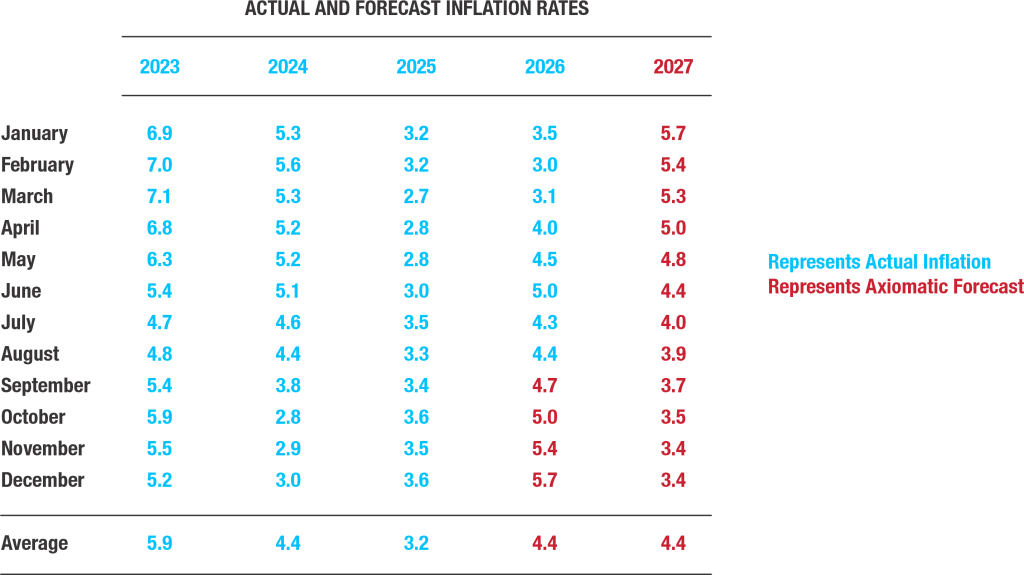
Our current model forecasts average South African inflation of approximately 4.4% for 2027. The profile is expected to be uneven: inflation may remain elevated during the first half of the year before easing towards the South African Reserve Bank’s 3% target later in 2027.
It is worth noting that Axiomatic’s average 2027 inflation forecast of 4.4% is somewhat higher than the South African Reserve Bank’s latest Monetary Policy Committee forecast of 4.0% for 2027. However, our forecast is not out of line with broader market expectations. Our view differs slightly insofar as we believe inflation may prove more persistent during the first half of 2027. Elevated fuel prices, global geopolitical tensions, transportation costs, administered price increases, services inflation and the risk of second-round wage and price effects could delay the return of inflation to the 3.0% target level. For this reason, we have adopted a more conservative planning assumption of 4.4%, which we believe is appropriate for salary budgeting purposes.
Figure 1: Actual inflation for 2023-2025 and Axiomatic forecasts for 2023-2027.
Current Inflation And Macroeconomic Environment
The 2027 outlook is being shaped by competing forces. The Reserve Bank’s lower 3% inflation target should anchor expectations over time, but the path back to target is unlikely to be smooth. The following factors are particularly relevant to salary planning:
- Fuel and global energy costs: South Africa remains exposed to international oil prices, refinery margins and disruptions to major shipping and energy routes. Higher fuel prices feed directly into transport costs and indirectly into food, manufacturing and distribution costs.
- Food inflation risk: Food inflation has recently been relatively contained, but higher diesel and fertiliser costs, possible El Niño conditions and disruption to global agricultural trade create upside risk.
- The rand: A resilient rand has helped contain imported inflation. However, the currency remains sensitive to global risk appetite, US monetary policy, commodity prices and domestic confidence.
- Administered prices and services: Electricity, municipal charges and other administered prices can remain above headline inflation.
- Interest rates and household pressure: Monetary policy remains restrictive as the Reserve Bank seeks to prevent fuel and food shocks from becoming embedded in expectations. Higher borrowing costs continue to constrain disposable income and business investment.
- Modest economic growth: South African growth remains subdued and vulnerable to global shocks. Electricity reliability has improved, but logistics, municipal services, water constraints, weak investment and unemployment continue to limit the pace of expansion.
For remuneration committees, the implication is that 2027 planning should not rely on benign inflation and to ensure that employees receive a real increase to protect their purchasing power in 2027.
What Is A Real Salary Increase?
A real salary increase is the portion of a salary adjustment that exceeds inflation. It represents the improvement in an employee’s purchasing power after allowing for the general rise in prices. If salary increases equal inflation, purchasing power is broadly maintained; if they are below inflation, purchasing power declines.
Nominal salary increase − inflation = real salary increase
For example, a 5.5% salary increase against inflation of 4.4% provides an approximate real increase of 1.1 percentage points.
Figure 2: Historical real salary increases and the five-year moving average.
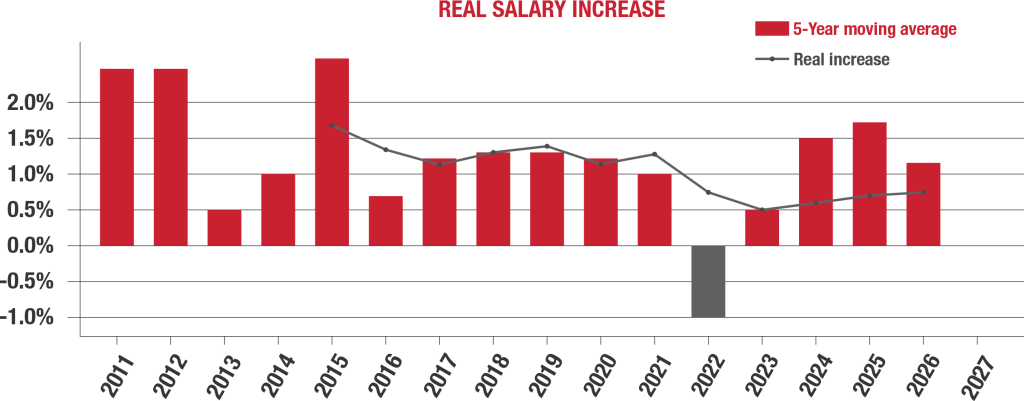
Historically, employers often added a larger real component to inflation. The standard practice in South Africa over the last 10 years has been to target a real salary increase of 1.0%; this target remains a reasonable planning convention that balances employee purchasing power, retention and employer affordability.
Forecast Of The 2027 Salary Increase
Applying Axiomatic’s mechanical methodology gives the following starting point:
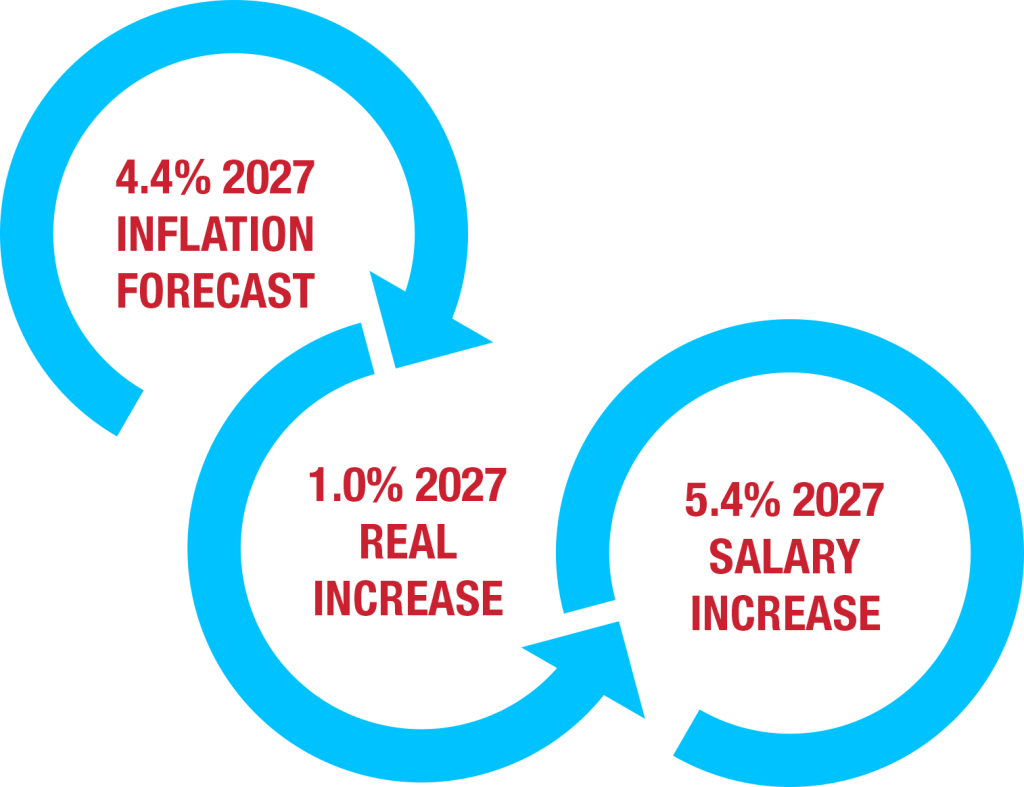
The mechanical result is 5.4%. We have rounded the recommendation to 5.5% to provide a practical budgeting figure and a modest buffer for the upside inflation risks described above.
Our initial South African salary increase forecast for 2027 is 5.5%.
Company-Specific Considerations
The 5.5% recommendation is a market-planning benchmark, not an automatic increase for every employer. Before finalising increases, organisations should consider:
- affordability and the organisation’s financial position
- collective bargaining outcomes and union expectations
- critical skills, retention risk and market positioning
- internal equity, pay compression and salary-range movement
- individual performance and progression
- the timing of the review cycle, particularly where increases take effect later in 2027
Forecasting inflation is particularly difficult in the current environment, given the interaction of global energy prices, geopolitical risks, food costs, the rand and administered prices. While our initial recommendation is therefore a 5.5% salary increase for 2027, this forecast remains sensitive to the timing and extent of the expected moderation in inflation. Any delay in inflation declining, or further inflationary spikes during the planning period, could justify revising the recommended salary increase to 6.0%.
Axiomatic will continue to monitor developments and update the recommendation as the outlook becomes clearer.
Ready To Plan Your 2027 Increases?
Talk to Axiomatic about building a defensible, inflation-linked salary increase forecast for your 2027 budgeting cycle.
COOKIE POLICY
Welcome to our website.
1. Introduction
This Cookie Policy explains how we use cookies and similar technologies on our website axioconsult.com. This policy is designed to help you understand what cookies are, how we use them, and the choices you have regarding their use.
2. What Are Cookies
Cookies are small text files that are stored on your device (computer, tablet, or mobile phone) when you visit certain websites. They are widely used to enhance your online experience by remembering your preferences and actions over time. Cookies are not harmful and do not contain personal information like your name or payment details.
3. How We Use Cookies
We use cookies for various purposes, including:
- Essential Cookies: These cookies are necessary for the basic functioning of our website. They enable you to navigate our site, use its features, and access secure areas.
- Analytical/Performance Cookies: These cookies help us understand how visitors use our website. They provide information about which pages are visited most frequently, how long visitors stay on each page, and whether they encounter any error messages. This data helps us improve the performance and usability of our website.
- Functionality Cookies: These cookies allow our website to remember choices you make (such as your username, language, or region) and provide enhanced, personalised features.
- Targeting/Advertising Cookies: These cookies are used to deliver advertisements that are relevant to your interests. They may also limit the number of times you see an ad and help measure the effectiveness of ad campaigns.
4. Your Cookie Choices
You have the option to manage your cookie preferences. You can usually modify your browser settings to accept, reject, or delete cookies. Please note that if you choose to block or delete cookies, some features of our website may not function properly.
5. Third-Party Cookies
We may allow third-party service providers to use cookies on our website for the purposes outlined in Section 3. These providers may also collect information about your online activities over time and across different websites.
6. Updates to This Policy
We may update this Cookie Policy from time to time to reflect changes in technology, law, or our data practices. Any changes will become effective when we post the revised policy on our website.
7. Contact Us
If you have any questions about our Cookie Policy or how we use cookies on our website, please contact us at
By continuing to use our website, you consent to the use of cookies as described in this Cookie Policy.