


JOINT COMMUNICATION 5 OF 2026 AND JOINT NOTICE 2 OF 2026 - TRUSTEE'S RESPONSIBILITY FOR REPORTING MATERIAL IT AND CYBER INCIDENTS
Effective 1 September 2026, retirement funds are required to report material IT and cyber incidents to the Financial Sector Conduct Authority (FSCA) using the prescribed reporting template submitted through the FSCA Joint Standards Submission Portal.
A Structured Three-Stage Reporting Process
Trustees must ensure that their incident management and governance frameworks can support a three-stage reporting process for material incidents:
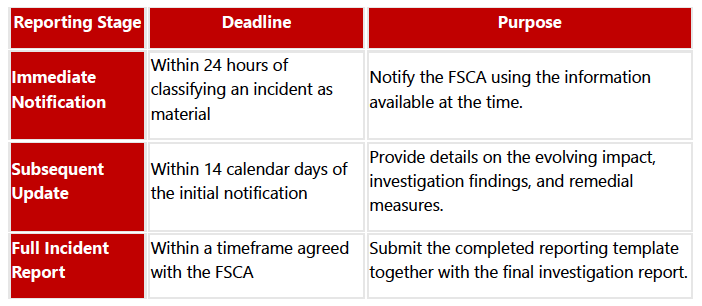
A critical point for trustees is that the 24-hour reporting period begins when the incident is classified as material, not when it is first detected. The requirement is measured in actual hours rather than business hours, making rapid decision-making essential.
Funds should therefore have established escalation procedures that enable key stakeholders, including the principal officer, trustees, administrators, IT and cybersecurity service providers, legal advisers, and communications teams, to assess incidents promptly and determine whether they are material.
Material Incidents Extend Beyond Technical Cyber Attacks
Assessing Materiality
Axiomatic’s advice is that trustees should consider whether the incident has had, or is likely to have, a severe and widespread impact on:
- Fund operations
- Services provided to members and beneficiaries
- The confidentiality, integrity, or availability of member data
- Contribution processing
- Benefit calculations and payments
- Third-party service providers and dependencies
- The broader financial system or economy
Trustees Remain Ultimately Accountable
Although many retirement funds rely extensively on administrators and external service providers for operational processing, technology infrastructure, and cybersecurity controls, regulatory accountability remains with the board of trustees.
- Identify, contain, and escalate relevant incidents without delay
- Provide sufficient information to support the fund's materiality assessment
- Preserve relevant evidence
- Cooperate fully with investigations
- Assist with regulatory reporting and member communications where required.
Managing Incomplete Information
Trustees should also note that reporting to the FSCA does not eliminate any separate notification obligations that may arise under the Protection of Personal Information Act (POPIA) or other applicable legislation. Each regulatory framework must be considered independently.
Axiomatic's Key Takeaway
Not Sure Your Fund's Reporting Framework Is Ready?
Talk to Axiomatic about reviewing your incident response plan, governance structures, and service provider agreements before the FSCA comes knocking.
COOKIE POLICY
Welcome to our website.
1. Introduction
This Cookie Policy explains how we use cookies and similar technologies on our website axioconsult.com. This policy is designed to help you understand what cookies are, how we use them, and the choices you have regarding their use.
2. What Are Cookies
Cookies are small text files that are stored on your device (computer, tablet, or mobile phone) when you visit certain websites. They are widely used to enhance your online experience by remembering your preferences and actions over time. Cookies are not harmful and do not contain personal information like your name or payment details.
3. How We Use Cookies
We use cookies for various purposes, including:
- Essential Cookies: These cookies are necessary for the basic functioning of our website. They enable you to navigate our site, use its features, and access secure areas.
- Analytical/Performance Cookies: These cookies help us understand how visitors use our website. They provide information about which pages are visited most frequently, how long visitors stay on each page, and whether they encounter any error messages. This data helps us improve the performance and usability of our website.
- Functionality Cookies: These cookies allow our website to remember choices you make (such as your username, language, or region) and provide enhanced, personalised features.
- Targeting/Advertising Cookies: These cookies are used to deliver advertisements that are relevant to your interests. They may also limit the number of times you see an ad and help measure the effectiveness of ad campaigns.
4. Your Cookie Choices
You have the option to manage your cookie preferences. You can usually modify your browser settings to accept, reject, or delete cookies. Please note that if you choose to block or delete cookies, some features of our website may not function properly.
5. Third-Party Cookies
We may allow third-party service providers to use cookies on our website for the purposes outlined in Section 3. These providers may also collect information about your online activities over time and across different websites.
6. Updates to This Policy
We may update this Cookie Policy from time to time to reflect changes in technology, law, or our data practices. Any changes will become effective when we post the revised policy on our website.
7. Contact Us
If you have any questions about our Cookie Policy or how we use cookies on our website, please contact us at
By continuing to use our website, you consent to the use of cookies as described in this Cookie Policy.