African Inflation Trends and What They May Mean for 2027 Salary Increases

As readers of our previous salary increase forecast reports will know, inflation remains the single most important input when assessing future salary increase expectations. While salary decisions are influenced by a range of factors, including company performance, labour market conditions, affordability, and skills availability, inflation continues to be the primary indicator when employers determine annual remuneration adjustments.
Consequently, understanding inflation trends provides one of the earliest and most reliable indications of where salary increase budgets for 2027 are heading.

Why Forecasting 2027 Salary Increases Is Particularly Difficult

Forecasting salary increases for 2027 remains challenging due to significant uncertainty in the global economic environment.
The ongoing conflict in the Middle East continues to create volatility in energy markets, with oil prices remaining one of the most significant risks to inflation forecasts worldwide. Sustained increases in energy costs have a direct impact on transportation, logistics, manufacturing and food prices, often feeding through into wider inflationary pressures.
At the same time, global supply chains remain vulnerable to geopolitical tensions, changing trade relationships, shipping disruptions and currency volatility. Many African economies are particularly exposed to these risks because they are net importers of fuel, machinery, technology and consumer goods. Currency depreciation against major international currencies can quickly translate into higher inflation and, ultimately, increased pressure on employers to provide larger salary adjustments.

The Axiomatic Approach to Salary Increase Forecasting

At Axiomatic, our proven methodology begins with forecasting the expected inflation rate for the relevant year. Historical experience consistently demonstrates a strong relationship between inflation and salary increase budgets.
While remuneration decisions are also influenced by labour availability, skills shortages, organisational performance and employee retention risks, inflation remains the foundation of most salary increase discussions. Employees naturally seek to preserve their purchasing power, while employers strive to balance this expectation against affordability and business sustainability.
For this reason, early inflation indicators often provide the first insight into the likely direction of future salary increase budgets.

What Current Inflation Trends Are Telling Us

Our preliminary assessment suggests that salary increase budgets across many developed economies are likely to continue moderating during 2027 as inflation moves closer to central bank targets.
The position across Africa, however, is considerably more varied.
Several African countries continue to experience elevated inflation because of currency weakness, fiscal pressures, imported cost increases and structural economic challenges. In these environments, employers may have little choice but to continue granting relatively high salary increases simply to prevent a significant erosion of employee purchasing power.

Countries such as Nigeria, Egypt and Angola and several other emerging African markets remain particularly exposed to inflationary pressures. In addition to inflation, employers in these markets must contend with currency volatility, competition for skilled talent, a shallow talent pool and increasing employee expectations regarding compensation.

As a result, salary increases in these markets are likely to remain materially higher than those observed in lower-inflation economies.

Early Planning for 2027

While it may be too early to finalise 2027 salary increase budgets, now is an appropriate time for organisations to begin monitoring inflation trends closely. Inflation data released during the remainder of 2026 and early 2027 will provide increasingly reliable indicators of likely salary increase expectations.

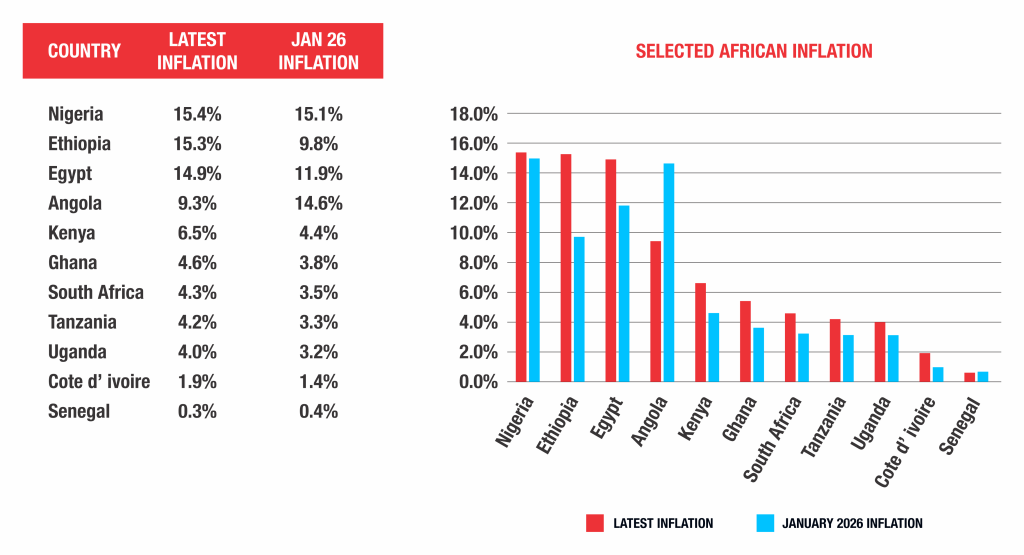
Current inflation

Countries experiencing elevated inflation, ongoing currency weakness and skills shortages are likely to continue seeing relatively high salary increase budgets as employers seek to preserve employee purchasing power and retain critical talent.
The table below enumerates the latest inflation rate and the inflation rate recorded in January 2026 in order to gauge the trend:
Later in the year we will start publishing our preliminary 2027 salary increase forecasts for certain African countries.

Optimise Your 2027 Remuneration Strategy Today

Navigating unpredictable market shifts and currency volatility across African markets makes proactive salary budget planning essential. Reach out to our team of compensation specialists to discuss your organisation’s strategy or to receive our upcoming detailed country-level forecasts.

COOKIE POLICY

Welcome to our website.

1. Introduction

This Cookie Policy explains how we use cookies and similar technologies on our website axioconsult.com. This policy is designed to help you understand what cookies are, how we use them, and the choices you have regarding their use.

2. What Are Cookies

Cookies are small text files that are stored on your device (computer, tablet, or mobile phone) when you visit certain websites. They are widely used to enhance your online experience by remembering your preferences and actions over time. Cookies are not harmful and do not contain personal information like your name or payment details.

3. How We Use Cookies

We use cookies for various purposes, including:

    • Essential Cookies: These cookies are necessary for the basic functioning of our website. They enable you to navigate our site, use its features, and access secure areas.
    • Analytical/Performance Cookies: These cookies help us understand how visitors use our website. They provide information about which pages are visited most frequently, how long visitors stay on each page, and whether they encounter any error messages. This data helps us improve the performance and usability of our website.
    • Functionality Cookies: These cookies allow our website to remember choices you make (such as your username, language, or region) and provide enhanced, personalised features.
    • Targeting/Advertising Cookies: These cookies are used to deliver advertisements that are relevant to your interests. They may also limit the number of times you see an ad and help measure the effectiveness of ad campaigns.


4. Your Cookie Choices

You have the option to manage your cookie preferences. You can usually modify your browser settings to accept, reject, or delete cookies. Please note that if you choose to block or delete cookies, some features of our website may not function properly.

5. Third-Party Cookies

We may allow third-party service providers to use cookies on our website for the purposes outlined in Section 3. These providers may also collect information about your online activities over time and across different websites.

6. Updates to This Policy

We may update this Cookie Policy from time to time to reflect changes in technology, law, or our data practices. Any changes will become effective when we post the revised policy on our website.

7. Contact Us

If you have any questions about our Cookie Policy or how we use cookies on our website, please contact us at

By continuing to use our website, you consent to the use of cookies as described in this Cookie Policy.